
Shopping cart
Article
0
Sum
0,00 EUR
*incl. tax excl. shipping
Trophy Bleaching 250 ml bone bleaching

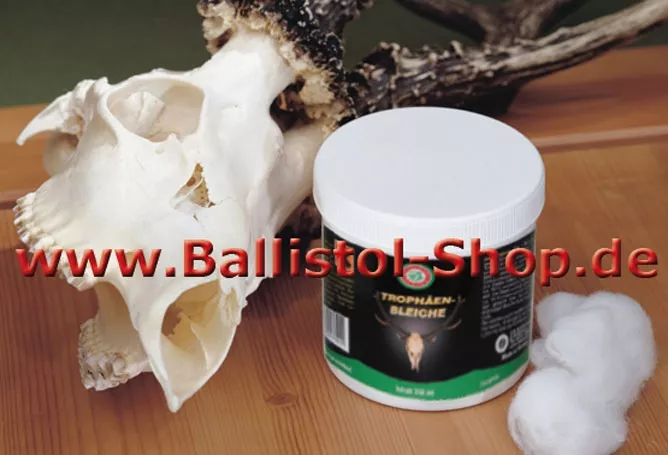
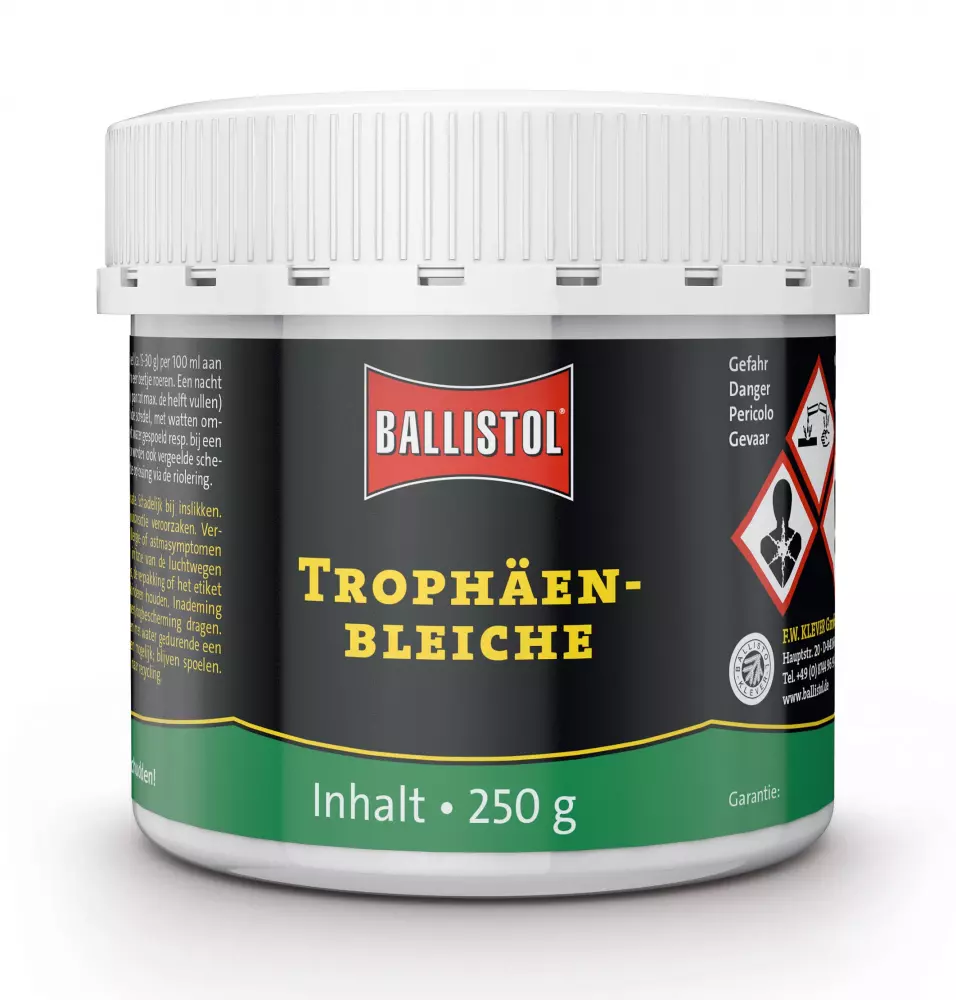
Klever trophy bleach and bone bleach makes hunting trophies and teaching specimens sparkling white again.
Skeletal parts, prepared bones, skulls and skeletons – whether as a hunter's trophy or as a teaching specimen for pupils and students in biology – simply look much better when the specimens are sparkling white.

With Klever trophy bleach and bone bleach you can bleach skulls and other bone parts pure white both for initial preparation and for restoration. This creates a much more pleasing sight both in teaching collections and in display cases with hunting trophies.
The trophy bleach contains two strong oxidising agents, sodium percarbonate and sodium persulfate, which oxidise organic substances to CO₂. The sodium percarbonate produces hydrogen peroxide in water. Heat supports and accelerates this oxidation process, which is why warming the solution increases or speeds up its effect. Boiling should be avoided; it is enough for the water to start simmering, i.e. for bubbles to rise slowly.
For the best and most even result possible, it is important to clean the trophy to be treated (e.g. skull) as thoroughly as possible first. It should be largely free of grease, tissue remnants and other residues. Pre-cleaning by boiling in water with a little detergent or washing-up liquid is common. This step is often underestimated but determines the result: on greasy areas or areas with tissue remnants, the bleach acts unevenly and the result will be blotchy rather than evenly white.
Add two level tablespoons (approx. 15–20 g) of trophy bleach per 100 ml to cold water. Depending on the degree of saturation, the powder dissolves completely or some remains undissolved. Please fill the pot no more than halfway, as heavy foaming can occur and the solution may overflow. It is important to use the bleach solution as fresh as possible. A solution that has already been used or has been standing for a long time without a trophy gradually loses its effect, as the active ingredients break down by themselves.
Immerse the cleaned skull in the solution and stir a little. Make sure as far as possible that all areas to be treated come into sufficient contact with the solution. Leave the skull in the solution overnight and then warm it to approx. 50 °C. Alternatively, you can wrap the skull in kitchen roll and repeatedly pour the bleach solution over it thoroughly.
After approx. 15 hours, rinse the trophy with water. If the bleaching is not yet complete, the process can be repeated. This makes even yellowed skulls pure white again.
After treatment, place the skull in a suitable, well-ventilated place to dry. Indirect sunlight is ideal. However, the skull should not be exposed to direct sun, as drying too quickly and unevenly can cause cracks. The UV radiation in daylight supports the bleaching process. After approx. 2 days, even soaked, darker areas on the trophy should be bright white.
The used solution can be disposed of via the sewer system.
The trophy bleach is a bleaching agent and must be handled accordingly. Always wear protective gloves, protective clothing and eye protection when using it. Avoid inhaling powder dust and any fumes produced, and only work in a well-ventilated area. Do not eat, drink or smoke while using the product, and wash your hands thoroughly after use. Store the product locked up and out of the reach of children.
Contents: 250 ml
Trophy treatment with steel wool Still an insider tip of the trophy treatment: Fine and finest steel wool in the degrees of fineness from 0 to 0000. Depending on the degree of fineness, you can create a finish on the trophy from semi-gloss to high-gloss. If you are working in a humid environment, a stainless steel wool is possibly of interest to you.
 Further Information
 Here you find all Gun oils at a glance
 Here you find all chemical and manual barrel cleaner
 Universal Gun care cloth for all surfaces and each chemial.
The spezial fabric of the gun care cloth is neutral against each surfaces and materials and extra absorbent.
 Here you find all Products for gun care at a glance.
 Get to know Ballistol Universal Oil – proven since 1904.
Kennzeichnung gemäß Verordnung (EG) Nr. 1272/2008 [CLP/GHS]



Customer reviews:
This product has not yet been rated.
Your question about
Do you have questions about this product?
We advise you gladly.
Customers who bought this product bought also the following products:
Similar products:
Other products from the same category: