

Shopping cart
Article
0
Sum
0,00 EUR
*incl. tax excl. shipping
PTFE Spray Ballistol Teflon Spray

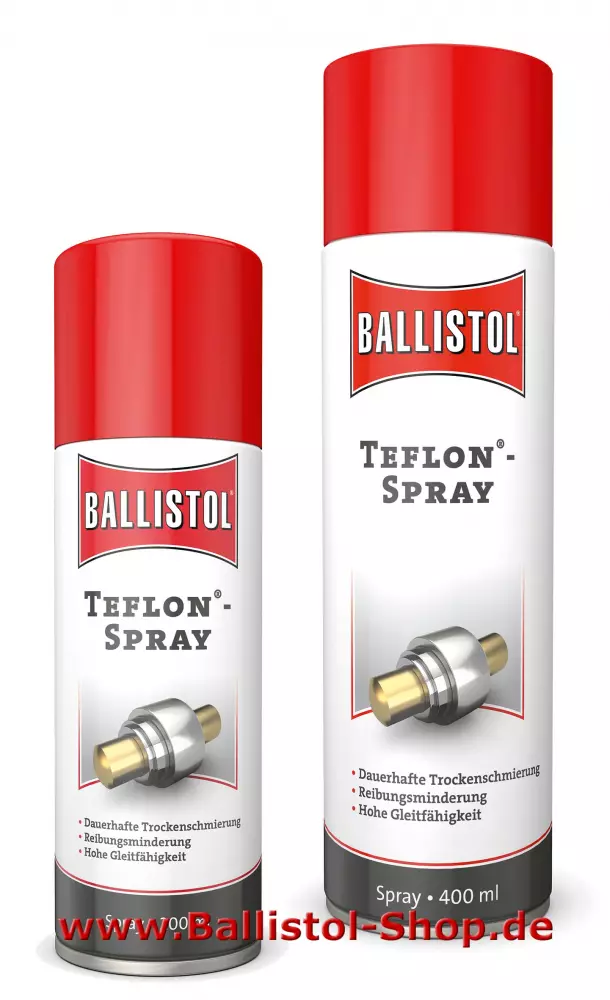
PTFE spray (polytetrafluoroethylene) is a lubricant, slip agent and non-stick agent that can also be used where dry lubrication is required.
In everyday language, this plastic is often referred to by the trade name Teflon™. Teflon™ is a trademark of The Chemours Company FC, LLC used under licence by F.W. Klever GmbH.
The most important properties at a glance:
PTFE spray
 Further Information
 Get to know Ballistol Universal Oil – proven since 1904.
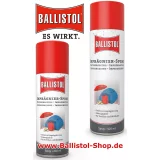
 This Waterproofing spray keeps tight – even with textile fiber or synthetic fiber. Watch our video and see yourself what, it is able to di in comparison with other impregnation sprays.
 Silicone-Spray is e.g. able to lube plastic without oil and fat.
 Assembly Spray facilitates assembly and disassembly and protects the surfaces.
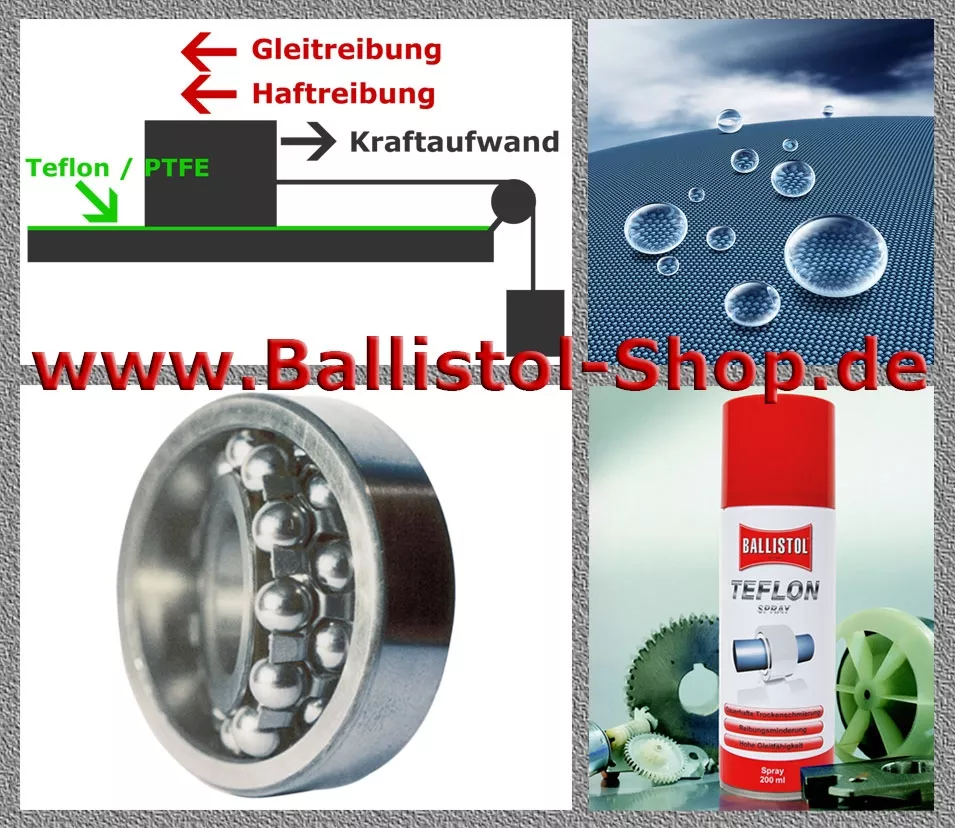
PTFE spray (polytetrafluoroethylene) provides dry lubrication for all materials such as metals, plastics, rubber, wood etc. PTFE spray is always a good choice when other lubricants such as mineral oils or silicones are undesirable during use or further processing. PTFE adheres even to microscopic surface irregularities, giving any material effective sliding properties. Treated surfaces are water-repellent, dust-repellent and protected against corrosion – all in a temperature range from -50 to +280 ºC.
The plastic PTFE is commonly referred to by the trade name Teflon™, which is mainly due to the history of the invention and further development of PTFE and Teflon™.
PTFE spray is suitable for a great many applications. The possibilities mentioned here can therefore only serve as examples:
PTFE spray is ideal, for example, for lubricating cables, chains, gearboxes, gears, conveyor belts, rollers, bearings, slideways, in precision mechanics, guide rails, telescopic slides and much more. PTFE spray is suitable for all materials such as metals, plastics, rubber, wood etc., which is why it is used in many areas of engineering. PTFE spray is used, for example, to lubricate fitness equipment or give it smooth-running properties, or to prevent moving metal parts from freezing. PTFE spray also keeps locks, hinges and other moving parts working smoothly, prevents squeaking and creaking and is suitable for tool care, bike care, motorcycle care, car care etc. It is also suitable for caring for garden tools such as pruning shears and, by greatly increasing slip, considerably reduces the effort required at the same time.
Always shake PTFE spray well before use so that the particles are evenly distributed in the carrier. The materials, objects or surfaces to be lubricated or made slippery must be clean, dry and free of grease. Spray the surfaces with PTFE spray from a distance of approx. 10 – 25 cm. Then allow the wet surfaces to dry for a few minutes before first touching them or before further processing or assembly. To further increase the effect, you can also apply several layers. Each layer must be dry before the next is applied. Polishing with a cloth increases the effect even more. Check synthetic materials for compatibility before use.
Contrary to popular belief, PTFE is not a by-product of space travel, which only began in 1957. It was discovered by chance back in 1938 by the chemist Roy Plunkett when, while searching for refrigerants for fridges, he was experimenting with tetrafluoroethylene (TFE) and one morning found only white crumbs in the bottle instead of gas. The gas had turned into PTFE. The manufacturing process still in use today is named the Plunkett process after its discoverer. In this process, polymerisation is initiated at high pressure with peroxides. In 1941, DuPont was granted the patent for PTFE.
You can find this and much more information on PTFE here.
If you are looking for more technical details on friction and reducing friction, Wikipedia has detailed information on tribology – the science of friction.
Kennzeichnung gemäß Verordnung (EG) Nr. 1272/2008 [CLP/GHS]

alles bestens, schnell Lieferung, immer gerne wieder
Gewohnte Ballistol-Qualität. Wie immer, alles optimal. Vielen Dank!
Macht was es soll, gerne wieder!
....heiter weiter!
Schon immer ein Top Produkt!
Klasse Produkt! Funktioniert einwandfrei und lieferung blitzschnell. Danke!
Passt. Tut was es soll.
Einmal bestellt, ab nun immer wieder!
habe es bisher erst einmal ausprobiert, alles o.k.
alles bestens, schnell Lieferung, immer gerne wieder
Your question about
Do you have questions about this product?
We advise you gladly.
Customers who bought this product bought also the following products:
Similar products:
Other products from the same category:
This information might be of interest to you: